
Share your specialized expertise on Art Times
Apply now
Photo: Art Times
Your expertise, an exclusive weekly feature in Art Times

Photo: Art Times
The Art Times provides a premier platform for distinguished art world expertise
We are opening our editorial space to prominent curators, historians, and market experts who prioritize intellectual discourse.
How it works

Photo: Art Times
Apply now
Fill out the form and send it to us. Include your social media links and, if available, your website so we can review your work.
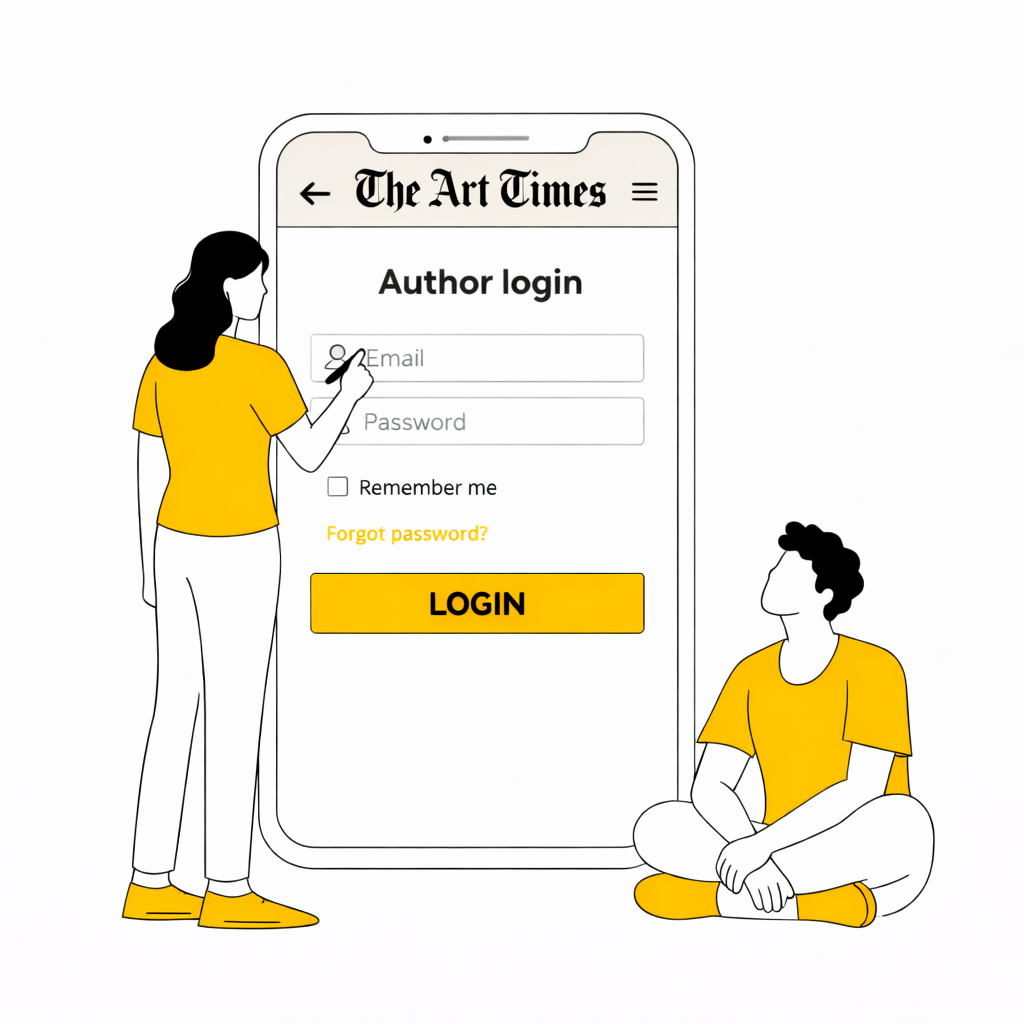
Photo: Art Times
Editorial Onboarding and Access to the Author Portal
To ensure the highest editorial standards, your personal access credentials will be provided within two business days. On your dedicated Author Page at thearttimes.com, you will find a professional workspace designed for you to compose your articles with focus and securely submit them to our editorial board.

Photo: Art Times
Once your contribution is finalized, you may formally transmit it to Art Times through your dedicated portal.

Photo: Art Times
Review process
Our experts review your submitted information and sources very strictly. This can take up to one week.
Photo: Art Times
Publication
After publishing, we email you the link and share materials for your social media.
Our recommendation

Photo: Art Times
Record a short professional video about your topic.
A one minute close up video can help your audience understand the value of your article.
If you create it, we can publish it on Art Times and our social channels with our branding and logo.
Frequently asked questions
Are there rules we should follow when writing?
Yes. Minimum 600 words, credible sources with links, clear structure, and no hidden promotion. We also recommend 750 words for stronger depth.
Can I use AI?
No. The article must be based on your expertise, your research, and your sources. Art Times reviews sources and claims very strictly.
How long do I have to finish my articles?
You have one week to submit 3 articles. If we do not receive them within that time, we will offer the topics to other specialized experts.
Can I remain anonymous?
Unfortunately not. We require transparency and professionalism for every published contribution.
Do authors get paid?
No. You gain international recognition and professional positioning in your field.
Our SEO team improves discoverability so your expertise can appear as a source in search results and in AI tools. You receive an Art Times author page with contact details and a dedicated inquiry form for work opportunities.
Art Times does not participate in those deals and takes no commission.
Do you offer paid publishing?
Yes. Use the inquiry page.
Pricing inquiryArt Times Editorial Principles and Journalistic Standards
Read the full editorial principles and journalistic standards
Art Times Editorial Principles and Journalistic Standards
Introduction
Art Times is committed to serious, credible, and culturally intelligent journalism. Our editorial work is guided by accuracy, independence, intellectual honesty, and respect for art, artists, authors, institutions, and readers. We do not publish to chase noise, speed, vanity, or algorithmic attention. We publish to inform, interpret, document, and contribute meaningfully to cultural discourse.
These principles define the editorial standards of Art Times across reporting, criticism, reviews, interviews, essays, profiles, analysis, features, and all other editorial formats. They apply to all editors, writers, contributors, freelancers, researchers, and collaborators working under the Art Times name.
Art Times stands for judgment, clarity, elegance, credibility, and responsibility.
1. Truth Before Speed
Art Times does not publish merely to be first. We publish when we have sufficient confidence in the accuracy, relevance, and integrity of the material.
Principle
Accuracy has priority over immediacy. Speed is never a justification for publishing incomplete, misleading, speculative, or poorly verified information.
Editorial Standard
All factual elements must be checked before publication, including names, titles, dates, institutions, locations, quotations, captions, and contextual claims. A fact is not fully verified if it is technically correct but stripped of relevant context. Art Times therefore verifies both factual content and surrounding context before publication.
Practical Application
When a story is developing and facts are still emerging, uncertainty must be stated clearly and explicitly. Rumors, online speculation, anonymous chatter, or repeated claims from unverified channels are not treated as established fact. If verification is incomplete, the material must either be withheld or framed honestly as incomplete.
Editorial Expectation
Every piece should be able to answer three core questions: What do we know? How do we know it? What remains uncertain? Writers and editors are expected to distinguish clearly between confirmed reporting, informed interpretation, and opinion.
What Art Times Rejects
Art Times rejects premature publication, rumor amplification, speculative framing presented as fact, and editorial shortcuts justified by competitive urgency.
2. Editorial Independence
Art Times protects editorial judgment from commercial, personal, institutional, political, and relational influence.
Principle
Editorial decisions must be shaped by journalistic value and cultural merit, not by money, access, favors, gifts, friendships, invitations, pressure, or fear of losing relationships.
Editorial Standard
No advertiser, sponsor, gallery, museum, publisher, author, artist, collector, brand, partner, or publicist may influence editorial conclusions. Invitations, preview access, hospitality, free products, or private relationships do not guarantee positive coverage and must never shape factual or critical judgment.
Practical Application
Writers and editors must remain able to decline access-driven arrangements that threaten impartiality. Editorial leadership retains final authority over what is covered, how it is framed, how it is edited, and whether it is published.
Editorial Expectation
Contributors must disclose relationships or circumstances that may compromise, or appear to compromise, their independence. Editorial independence must be preserved not only in substance, but also in perception.
What Art Times Rejects
Art Times rejects access journalism, soft coverage exchanged for favors, positive treatment tied to business interests, and hidden personal influence over editorial outcomes.
3. Clear Separation of Editorial and Commercial Content
Readers must never be left guessing whether a piece is journalism, sponsored content, advertising, or promotion.
Principle
Editorial and commercial material must be clearly separated in function, presentation, language, and labeling.
Editorial Standard
Advertorials, sponsored features, paid placements, partnerships, affiliate-linked content, and promotional collaborations must be labeled clearly and transparently. Such labeling must be visible, understandable, and unambiguous to the ordinary reader.
Practical Application
Commercial content must not be disguised as independent editorial work. Design, wording, layout, and placement must not intentionally blur the boundary between journalism and promotion. Editorial voice must not be used to conceal paid influence.
Editorial Expectation
A reader should be able to identify immediately what kind of content is being presented. Internal processes must preserve structural separation between editorial judgment and commercial activity.
What Art Times Rejects
Art Times rejects disguised advertising, vague sponsorship language, misleading native content, and any format that obscures the commercial nature of a piece.
4. Substance Over Hype
Art Times values depth, meaning, and cultural relevance over noise, trend-chasing, and superficial momentum.
Principle
Every published piece should offer genuine editorial value. We do not publish solely because something is fashionable, visible, or already circulating widely.
Editorial Standard
Coverage should add insight, context, analysis, and interpretation. Profiles should go beyond publicity narratives. Reviews should evaluate substance, not simply summarize marketing language. Features should explain not only what is happening, but why it matters.
Practical Application
Writers are expected to engage the cultural, artistic, intellectual, social, or historical significance of a subject. A piece should help readers understand meaning, not merely observe surface activity.
Editorial Expectation
Editorial work must aim for insight rather than noise. Strong journalism should deepen understanding, not merely generate reaction.
What Art Times Rejects
Art Times rejects empty trend amplification, superficial hype, shallow rewrites of promotional material, and publication without clear intellectual or cultural value.
5. Fairness Toward People and Institutions
Art Times seeks to be rigorous without being careless, critical without being abusive, and honest without being defamatory.
Principle
Artists, authors, curators, galleries, publishers, institutions, brands, and cultural actors must be represented fairly, accurately, and proportionately.
Editorial Standard
Criticism is legitimate and necessary, but it must be grounded in reason, evidence, and defensible editorial judgment. Strong evaluation must rest on observable facts, relevant documentation, or clearly argued critical reasoning. No individual or institution should be mischaracterized through distortion, omission, insinuation, or rhetorical excess.
Practical Application
Where fairness requires it, relevant parties should have the opportunity to respond to serious claims. Tone must remain professional even when criticism is strong. Personal ridicule, humiliation, mockery, and speculative character attacks have no place in Art Times journalism.
Editorial Expectation
Writers and editors must evaluate whether wording is fair, proportionate, and supported. A sharp argument is acceptable; a careless or needlessly damaging one is not.
What Art Times Rejects
Art Times rejects defamation, innuendo, personal contempt disguised as criticism, and any editorial approach that creates reputational harm without sufficient factual basis.
6. Precise Source Work
Credible journalism depends on disciplined sourcing, verifiable evidence, and responsible editorial judgment.
Principle
All factual claims must be grounded in reliable, appropriately weighted, and verifiable sources.
Editorial Standard
Primary sources are preferred whenever reasonably available. These may include interviews, official statements, catalogues, archival records, books, exhibition materials, legal filings, public data, firsthand observation, and other direct documentation. Secondary sources may be used when credible and relevant, but they do not replace primary verification where primary material is accessible.
Practical Application
Sources must be assessed for authority, proximity, expertise, motivation, and reliability. A repeated claim is not automatically a verified claim. A single source may be insufficient for matters of consequence. Quotations must be accurate and preserved in proper context.
Editorial Expectation
Writers should understand the evidentiary basis of each substantive assertion. Editors should challenge unsupported statements, vague sourcing, and claims based on weak authority.
What Art Times Rejects
Art Times rejects circular sourcing, unsupported factual assertions, careless quote handling, and the treatment of press materials as neutral evidence without scrutiny.
7. Transparency About Uncertainty and Corrections
Credibility is strengthened by honesty about what is known, what is uncertain, and what must be corrected.
Principle
If something is not fully verified, it must not be presented as settled fact. If an error is made, it must be corrected openly and responsibly.
Editorial Standard
Uncertainty must be stated directly. Missing information must not be filled with assumption. Significant factual errors must be corrected in a visible and meaningful manner. Silent correction of material mistakes is inconsistent with editorial integrity.
Practical Application
The seriousness of a correction should match the seriousness of the error. Readers should not be misled into believing a false statement was never published if the original error was substantial. Vague distancing language is not a substitute for real transparency.
Editorial Expectation
Writers and editors must report possible errors internally and handle corrections without defensiveness. Correction practice is part of editorial discipline, not a sign of weakness.
What Art Times Rejects
Art Times rejects hidden corrections, false certainty, unacknowledged factual revisions, and language that conceals uncertainty behind polished phrasing.
8. Respect for Art, Authorship, and Intellectual Property
Art Times treats creative labor, authorship, attribution, and rights as serious matters.
Principle
No plagiarism, no unauthorized appropriation, no careless use of protected work, and no disregard for artistic or intellectual ownership.
Editorial Standard
All published material must be original or properly quoted, credited, licensed, or otherwise used within lawful and ethical boundaries. This includes text, images, excerpts, captions, ideas, archival materials, and translations.
Practical Application
Image rights, reproduction permissions, artist credits, author attributions, quotation accuracy, and copyright issues must be handled carefully. Paraphrasing must not conceal dependence on another source. Translations and adaptations must preserve meaning and respect source integrity.
Editorial Expectation
Editors and contributors must treat provenance, attribution, permissions, and credits as part of professional quality control.
What Art Times Rejects
Art Times rejects plagiarism in every form, image misuse, misattribution, unattributed borrowing of ideas or phrasing, and casual handling of intellectual property.
9. International Perspective with Cultural Sensitivity
Art Times operates with an international outlook and a disciplined awareness of cultural, historical, and linguistic context.
Principle
Global coverage must be informed, respectful, and resistant to simplification, stereotype, and cultural flattening.
Editorial Standard
When writing across countries, traditions, languages, and histories, contextual accuracy matters. Writers must avoid exoticizing, generalizing, or imposing narrow assumptions on unfamiliar cultural realities.
Practical Application
Naming conventions, translation choices, references to identity, heritage, religion, nationhood, and local practice should be checked carefully. Historical context should be included where relevant. Cultural specificity should be treated as part of accuracy, not as optional decoration.
Editorial Expectation
Writers and editors should recognize that serious cultural journalism requires sensitivity to language, history, and context, especially when addressing subjects outside their immediate environment.
What Art Times Rejects
Art Times rejects cultural condescension, exoticizing language, historical ignorance, and reductive narratives imposed on complex realities.
10. Elegance in Language and Editorial Conduct
Art Times values precision, dignity, stylistic discipline, and professional composure.
Principle
Language should be clear, intelligent, and refined. Style must elevate meaning, not distract from it.
Editorial Standard
Headlines, subheads, captions, and article prose should be accurate, proportionate, and controlled. Writers should avoid cheap sensationalism, manipulative drama, inflated vocabulary, and aggressive rhetorical performance.
Practical Application
Strong writing does not require exaggeration. Authority should come from precision, clarity, and judgment. The voice of Art Times should be serious, polished, culturally literate, and measured.
Editorial Expectation
Every piece should reflect editorial discipline in tone, structure, and phrasing. Language should neither flatten the subject nor artificially inflate it.
What Art Times Rejects
Art Times rejects tabloid language, theatrical outrage, self-important prose, empty prestige vocabulary, and sensational tone used to simulate importance.
11. Relevance to Readers and the Cultural Field
Art Times publishes with purpose. Editorial work must justify its place.
Principle
Every published piece should be able to answer why it matters, to whom it matters, and what value it adds.
Editorial Standard
A subject is not automatically publishable merely because it exists, is visible, or is aesthetically pleasing. Relevance may be cultural, artistic, intellectual, historical, social, professional, or public-facing, but it must be real.
Practical Application
Writers should identify the editorial purpose of a piece before publication. A review may clarify artistic value. A feature may explain context. A profile may illuminate a serious body of work. A report may document an important development. Editorial purpose must be evident.
Editorial Expectation
Editors should ask not only whether a piece is interesting, but whether it is meaningful and useful to the reader and the cultural conversation.
What Art Times Rejects
Art Times rejects empty visibility, decorative content without substance, and publication that exists only to fill space or maintain volume.
12. Responsibility in the Digital Age
Digital publishing creates additional responsibilities in framing, discovery, metadata, and audience trust.
Principle
Digital strategy must support good journalism, not distort it.
Editorial Standard
Headlines, previews, metadata, search descriptions, social text, and distribution language must accurately reflect the content they represent. SEO may support discoverability, but it must never degrade substance or mislead readers.
Practical Application
An article must fulfill the promise of its title. Search optimization should serve clarity, relevance, and access to strong content, not produce thin pages, repetitive phrasing, or manipulative wording. Metrics may inform distribution, but they must not dictate editorial values.
Editorial Expectation
Editorial teams should treat digital packaging as part of journalistic ethics. Visibility should be built on quality, structure, and accuracy.
What Art Times Rejects
Art Times rejects clickbait, manipulative ambiguity, SEO-driven filler, misleading headlines, and digital tactics that weaken trust.
13. Disclosure of Conflicts of Interest
Trustworthy journalism requires careful identification and management of conflicts of interest.
Principle
Any personal, financial, professional, institutional, or relational connection that may compromise impartiality must be taken seriously.
Editorial Standard
Writers, editors, and contributors must disclose relevant conflicts before working on a subject where impartiality may reasonably be questioned. These may include employment history, personal relationships, advisory roles, representation, partnerships, financial interests, or direct involvement in the matter being covered.
Practical Application
Not every connection requires public disclosure, but every material connection requires internal editorial review. In some cases, disclosure is sufficient. In others, reassignment or recusal is the more appropriate response.
Editorial Expectation
Editorial leadership must evaluate potential conflicts carefully and act in a way that protects trust, fairness, and institutional credibility.
What Art Times Rejects
Art Times rejects undisclosed vested interests, compromised coverage, and the casual treatment of relationships that materially affect independence.
14. No AI-Generated Research as a Journalistic Fact Source
Art Times does not accept AI-generated research as a sufficient basis for factual journalism.
Principle
At the current stage of technological development, AI-generated outputs are not considered reliable enough to function as factual source material in journalistic research.
Editorial Standard
AI systems must not be treated as authoritative sources for facts, chronology, quotations, attribution, legal claims, or reporting conclusions. Journalistic research at Art Times must be based on human-led verification, primary sources, credible documents, direct reporting, and responsible editorial judgment.
Practical Application
AI tools may not replace reporting, interviewing, archival research, source evaluation, or fact-checking. If AI is used for auxiliary support in limited editorial workflows, every factual element must still be independently verified by human editorial processes before publication.
Editorial Expectation
Responsibility for truth remains fully human. Editors and writers are accountable for every factual claim published under the Art Times name.
What Art Times Rejects
Art Times rejects AI-generated research as a substitute for reporting, AI summaries treated as factual evidence, and automated outputs used without independent human verification.
15. Quality Over Quantity
Art Times values selectivity, consistency, and editorial level over volume.
Principle
It is better to publish fewer pieces of real quality than many pieces of low value.
Editorial Standard
Publication volume must never become a substitute for editorial strength. Frequency is not a meaningful achievement if it weakens accuracy, elegance, judgment, or reader trust.
Practical Application
Writers should be given space to think, verify, and build substance. Editors should commission based on merit, relevance, and distinctiveness rather than pressure to increase output. Not every possible topic deserves publication.
Editorial Expectation
Art Times should be recognized for reliability, level, selectivity, and seriousness. Editorial restraint is part of brand integrity.
What Art Times Rejects
Art Times rejects content inflation, repetitive low-value publishing, thin editorial production, and quantity-driven degradation of standards.
16. Clear Distinction Between Reporting, Criticism, Analysis, and Opinion
Different editorial forms require different standards, and readers should not be misled about what they are reading.
Principle
Reporting, criticism, analysis, essays, and opinion may coexist, but they must not be blurred in dishonest or confusing ways.
Editorial Standard
Reporting should be rooted in verified facts and disciplined sourcing. Criticism should offer reasoned judgment. Analysis should interpret developments with intellectual clarity. Opinion may be strong, but it must still be responsible, informed, and fair.
Practical Application
The framing, tone, and structure of a piece should make its nature clear. Readers should not have to guess whether a text is reporting facts, offering evaluation, or arguing a position.
What Art Times Rejects
Art Times rejects disguised opinion presented as reporting and criticism unsupported by evidence or serious thought.
17. Interview Integrity
Interviews are editorial works, not mere promotional channels.
Principle
An interview must preserve accuracy, meaning, and editorial independence.
Editorial Standard
Questions should be relevant, prepared, and editorially justified. Answers must not be edited in ways that distort meaning. Readability edits may be appropriate, but substantive changes that alter intent are not.
Practical Application
Interview subjects should not receive covert control over framing, conclusions, or surrounding editorial interpretation. Promotional talking points should be evaluated critically, not passed through untouched.
What Art Times Rejects
Art Times rejects interview manipulation, distortion through selective editing, and interviews used as disguised promotional material without editorial scrutiny.
18. Review Ethics
Reviews are one of the clearest forms of editorial judgment and therefore demand seriousness, consistency, and independence.
Principle
A review must be an honest, defensible critical assessment of the work itself.
Editorial Standard
Praise must be earned. Criticism must be argued. Personal relationships, access, gifts, expectations, or commercial considerations must not shape conclusions.
Practical Application
A review should assess substance, execution, context, coherence, originality, and relevance where applicable. It should not become a publicity summary or a vehicle for personal hostility.
What Art Times Rejects
Art Times rejects promotional reviewing, dishonest praise, gratuitous hostility, and critical language without substance.
19. Archival Responsibility
Published editorial work forms part of the cultural and digital record.
Principle
The Art Times archive should be treated as a serious body of record, not disposable content.
Editorial Standard
Published work should be maintained with care. Metadata, dates, titles, corrections, and attributions should remain coherent and reliable over time.
Practical Application
Where material errors are discovered after publication, the archive should be corrected responsibly. Editorial history should not be carelessly erased or obscured.
What Art Times Rejects
Art Times rejects negligent archival practice, unstable attribution, and careless treatment of published editorial history.
20. Accountability to Readers
Trust is not declared. It is earned repeatedly through conduct.
Principle
Art Times is accountable to readers through accuracy, fairness, editorial honesty, and correction discipline.
Editorial Standard
Readers’ time, intelligence, and trust must be respected. Editorial work should not manipulate, mislead, or overpromise. Public credibility depends on consistent standards, not isolated statements of principle.
Practical Application
Art Times should be willing to clarify, correct, and refine where necessary. We regard trust as a core editorial asset and protect it accordingly.
What Art Times Rejects
Art Times rejects reader manipulation, false promises, evasiveness, and any editorial practice that treats trust as expendable.
Statement
Art Times exists to publish journalism and cultural writing with seriousness, refinement, and credibility. We aim to be thoughtful without pretension, rigorous without cruelty, and visible without compromising editorial standards. We believe cultural journalism should not merely circulate information, but clarify significance. It should document the present responsibly, interpret the cultural field intelligently, and do so in language worthy of the subject.
For Art Times, quality, trust, editorial discipline, and cultural seriousness are not optional additions to the brand. They are the brand.